
Consider the following analogy:
Reality — and truth — is a kind of infinite, invisible field that surrounds us. This field of reality, which is impossible for us to perceive directly, contains everything in the entire universe.
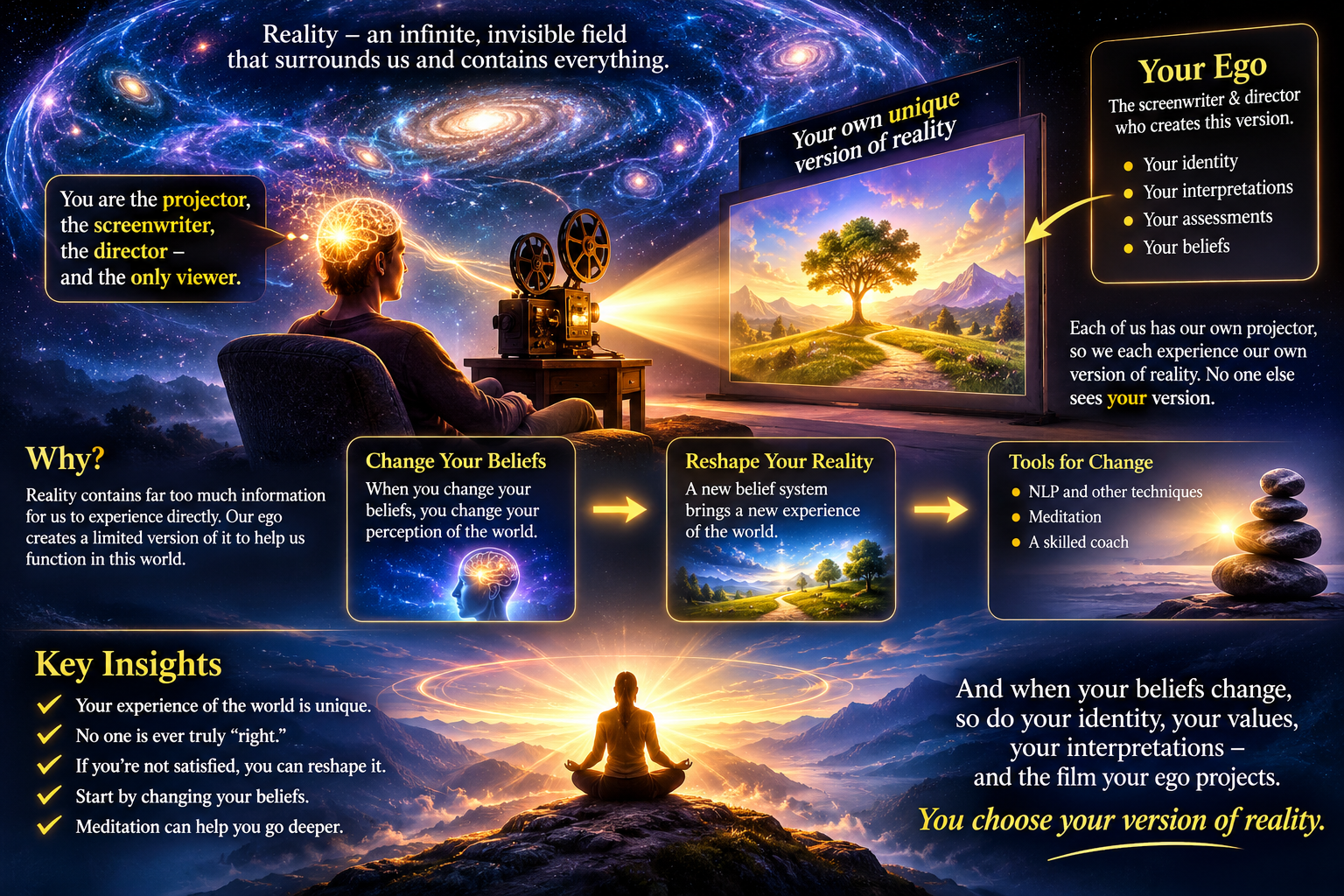
Within this field, there is a sort of projector that displays a very limited version of the surrounding reality onto a screen.
In this analogy, you are both the projector — which displays this version of reality — and the one who watches and experiences what is being projected. Furthermore, because you are the projector, you are also the screenwriter and director of the production being projected.
You are the only person watching and experiencing the film created and displayed by this projector. No one else can see it, because each of us has our own projector — or rather, we are each our own unique projector — watching and experiencing our own individual version of the reality that surrounds us.
We Choose Our Own Version of Reality
As humans, we do not have the ability to experience reality as it is. It simply contains far too much information for us to experience and comprehend it. In addition, that reality is constantly growing and evolving at such a high speed that we cannot possibly keep up with that speed.
Because of this, we have to create our own, very limited version of that reality.
As I mentioned, you are the screenwriter, the director and the only viewer of that show presented by your own projector. Or to be a little more specific: the screenwriter and director of the show is your ego.
The task of your ego is e.g. to make some sense of the surrounding world (reality) and present a version of it to yourself according to which you live and navigate in this world. This version contain e.g. your identity and your interpretations and assessments of everything. These, on the other hand, are largely based on your beliefs about yourself, other people and the world around you.
Without our ego and the interpretations and assessments it makes, it would be practically impossible for us to function in this world of ours. So it is important to understand that we do not live in reality, but in our self-created version of it. In human history, only a few enlightened people have experienced – and are experiencing – reality almost as it is. And when they are in an enlightened state, it is very difficult, almost impossible, for them to function in this world without help.
This image has been created using AI
What Does This Mean, Then?
Since we each have our own unique perception of reality, we never experience the world in the exact same way as anyone else. This is why we frequently find ourselves in disagreement with other people. Once you grasp this, you realize that, in truth, none of us is ever truly “right.” Ultimately, it always comes down to our own individual interpretations.
Likewise, if you are not satisfied with your experience of the world, you have the power to reshape it. The easiest way to begin is by adjusting your own belief system. When you change your beliefs, you alter your ego’s interpretations and its perception of the world.
How Can You Reshape Your Own Beliefs?
To change your beliefs, the most important step is to identify those that no longer serve you — the ones you wish to transform. This is best achieved through various techniques, meditation, and/or the guidance of a skilled coach. Often, especially in the beginning, it is difficult to recognize our own beliefs on our own; therefore, working with a skilled coach is frequently the best way to get the process started.
There are many different techniques available for changing beliefs. Over the years, I have personally made extensive use of NLP (Neuro-Linguistic Programming). There is also a vast array of other approaches and techniques to choose from — simply use what works for you.
Once you have gained some experience in shifting your beliefs using your chosen techniques — and once you have begun to truly believe that such change is possible — I highly recommend incorporating meditation.
For many, meditation is challenging at first, but I believe that anyone can learn it. There are countless styles and techniques; experiment with them and stick with those that resonate with you. Furthermore, as your meditation skills develop, I strongly suggest progressing toward more advanced meditation practices and methods.
Of course, our experience of the world is shaped by factors beyond those I have presented in this analogy, but by changing your beliefs, you also change, among other things, your value system, your identity, and your interpretations of things.
And when those things change, the screenplay and direction created by your ego about what you present to yourself as the truth via your projector also change.
